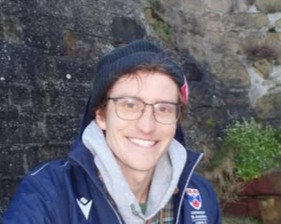
About Me
I am a 2ed year PhD student in the St Andrews Climate Dynamics Lab and the St Andrews Ocean Dynamics Lab, where I am supervised by Michael Byrne and Graeme MacGilchrist.
My research focuses on the physical processes that control climate change, with particular emphasis on terrestrial humidity, land–atmosphere interactions, and large-scale climate dynamics. I am interested in understanding not only how much the climate will change, but why it responds in the way that it does.
I use climate models, observations, and simple physical theory to investigate the fundamental controls on climate responses in a warming world. In particular, I am interested in connecting large-scale atmospheric dynamics with regional climate responses, improving our physical understanding of the processes controlling thermodynamic responses over land, and using this understanding to improve confidence in climate projections. Much of my work involves combining large climate model ensembles with relatively simple physical ideas to try to understand the mechanisms hiding behind the spread in climate projections.
My Research Journey
My route into climate research was somewhat indirect. My first experience of academic research came through an internship at the University of Maine, where I worked with Damian Brady in a marine biology lab investigating the environmental impacts of offshore wind development. I spent three months analysing environmental impact assessments and quickly discovered that I really enjoyed the process of research: figuring out what we actually know, identifying what we don’t, and trying to develop a quantitative way of answering the question.
Although I enjoyed the research, I wasn’t convinced that offshore wind development was where I wanted to focus my career. During the internship, however, I became involved in a project developing a micro-economic model and an interactive application to explore growing methodology choices for sea scallop aquaculture in the Gulf of Maine. This introduced me to the combination of quantitative modelling, data analysis, and scientific communication, and eventually contributed to my first academic paper, Techno-Economic Analysis of Atlantic Sea Scallop, Placopecten magellanicus, Aquaculture in the Gulf of Maine.
In my final year as an undergraduate at the University of St Andrews, I undertook a research dissertation with Anna Mackie and my now-supervisor Michael Byrne. This was my first real exposure to climate model data and inter-model comparison. My dissertation, “Comparing Component Cloud Feedbacks Across Varying Horizontal Resolutions,” investigated how cloud feedbacks varied across climate models and resolutions in the Radiative Convective Equilibrium Model Intercomparison Project. We didn’t exactly uncover the next big breakthrough in climate science, but I had a lot of fun doing it—and, more importantly, I became fascinated by the idea that we could use differences between climate models to learn something about the physical processes governing climate change.
That project convinced me that I wanted to continue down the climate dynamics rabbit hole.
After graduating in July 2024, I spent the summer working for the Appalachian Mountain Club in the White Mountains of New Hampshire before returning to St Andrews to begin my PhD in the School of Earth and Environmental Sciences in October 2024. I originally began my PhD working on developing an emergent constraint on extreme temperature response in a warming world. Since then, my research has evolved towards a broader interest in understanding the physical mechanisms controlling climate responses over land, particularly the role of humidity, atmospheric circulation, and land–atmosphere interactions.
When Im not working
I’m originally from Brunswick, Maine, and have always enjoyed spending time outside. These days, most of that time is spent running and hiking. I particularly enjoy long-distance running and exploring the mountains, and living in Scotland has provided plenty of opportunities for both. I’m generally happiest when I have a pair of running shoes on and a trail to follow (or if my code ran on the first try).